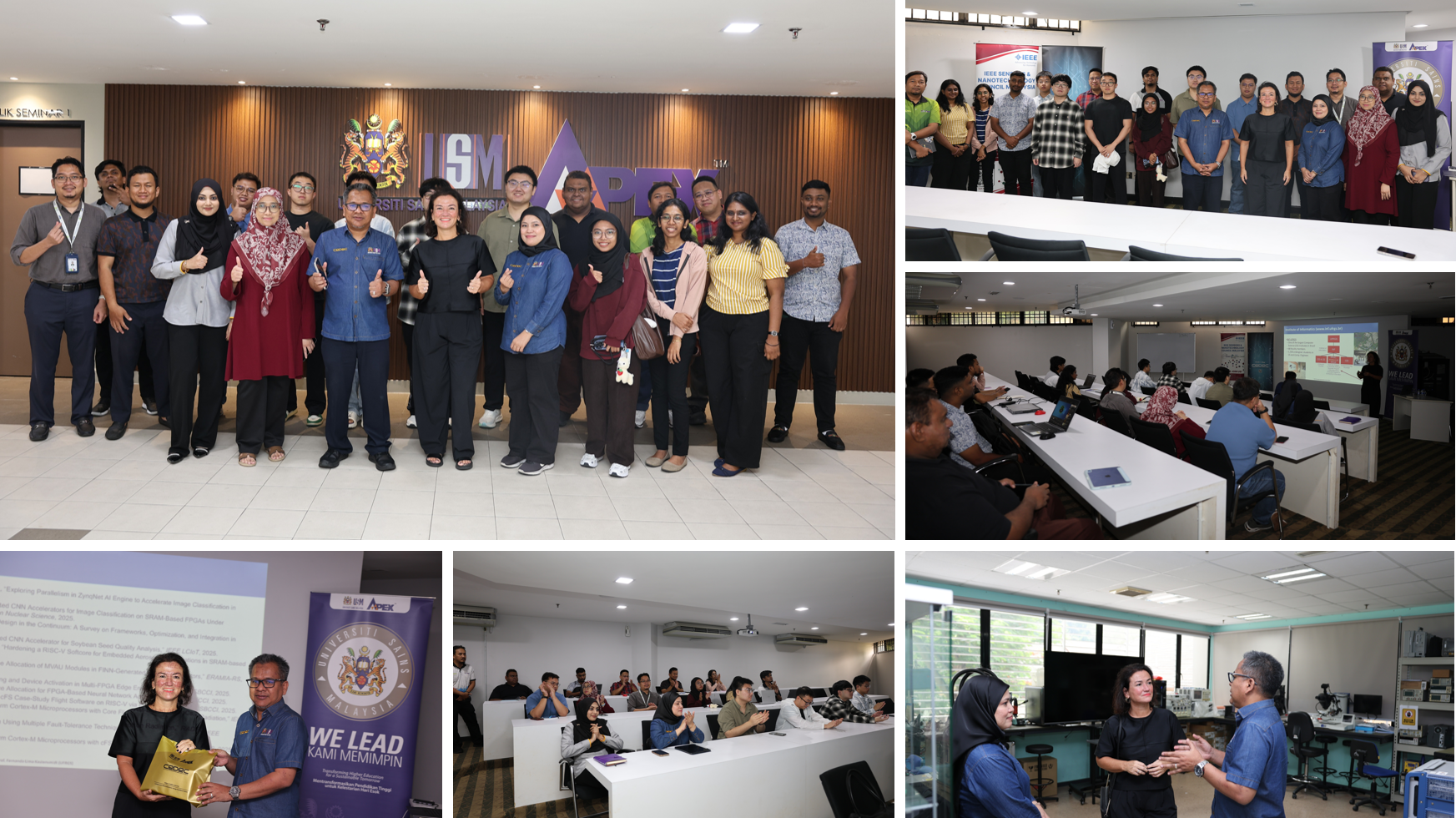
29 April 2026 – The Collaborative Microelectronic Design Excellence Centre (CEDEC) successfully organized a technical talk at Sains@USM, bringing together academics, researchers, and students to explore the latest developments in microelectronics and space-based AI systems.
The session, titled “Using Fault Tolerant AI Accelerators into SRAM-FPGAs for Earth Observation,” was delivered by Prof. Fernanda Gusmao de Lima Kastensmidt, Administrative Director of the Brazilian Society of Microelectronics. Held at Auditorium B, Sains@USM, Bukit Jambul, the talk highlighted recent advancements in designing resilient AI accelerators implemented on SRAM-based Field-Programmable Gate Arrays (FPGAs), particularly for applications in space environments.
In her presentation, Prof. Fernanda emphasized the increasing importance of on-board processing in satellites. By embedding Convolutional Neural Networks (CNNs) into FPGA-based systems, satellites can analyze Earth observation data in real time, reducing communication bandwidth with ground stations and enabling faster decision-making.
She also addressed the challenges posed by space radiation, including Total Ionizing Dose (TID) and Single Event Effects (SEEs), which can disrupt electronic components and lead to system failures. These issues are especially critical in SRAM-based FPGAs, where configuration memory is highly sensitive to radiation-induced upsets.
To overcome these challenges, the talk introduced several fault-tolerant design techniques such as Triple Modular Redundancy (TMR), configuration scrubbing, and error detection and correction methods. These strategies are essential in ensuring reliable operation of AI systems in harsh space environments.
The session further explored system-on-chip architectures integrating RISC-V processors with AI accelerators, along with various FPGA-based design approaches including FINN, ZynqNet, and systolic arrays. Key design challenges such as limited computational resources, memory bandwidth, and power constraints were also discussed.
Real-world applications were presented through case studies involving satellite missions and Earth observation datasets, demonstrating how hardware-software co-design can enhance system robustness and performance in orbit.
The talk forms part of ongoing efforts by CEDEC and its collaborators to strengthen Malaysia’s capabilities in semiconductor design and advanced computing technologies, while fostering knowledge exchange between international experts and the local research community.
